We all struggle to find meaning sometimes, especially in genuinely difficult circumstances. It may seem like nothing we do moves the dial in our favour and even those close to us don’t seem to see or understand us. Or maybe even things that once held meaning now feel tainted and we can’t articulate why. Or perhaps we’re frustrated by the constant search for meaning that leaves us more empty and restless than we were before.
This kind of existential malaise is different to nihilism, which holds that all of life, including our individual and collective range of thoughts, feelings, experiences and choices, is inherently meaningless. I would argue that despondency is not the total absence of hope, but rather the tension that remains when hope exists without anything concrete to attach to. Ennui might sound chic, but this kind of internal conflict is not a pleasant place to live for long.
So what can be done?
Many things as it happens. Some of these I’ve written about before. I’ve taken this chance to consolidate these, and some additional concepts, below.
- Go back to basics
This idea goes beyond adequate sleeping, eating, fresh air, movement and hydration. By back to basics I mean all of these things plus two more elements:- Check what information/rhetoric you are consuming – if it leaves you confused or despairing, consider changing your information diet.
- Reconnect with the world through each of your senses – taking the time to really engage with everyday activities can reignite our sense of wonder, if we choose to find the meaning in the mundane.
- Consider the how an ordinary life is inherently extraordinary
How often do we catch ourselves wishing we were something different to what we are – more talented, eloquent, confident or less prone to awkwardness, failure and mistakes – because these are the qualities we think might lift us beyond the ordinary? Or maybe we yearn for the proverbial status symbols – six-figure salary, bigger house, flashier car, newest gadgets, round-the-world trips – as a way of feeling extraordinary.
Comparison may well be the thief of joy, but it’s also our default. This skill, along with our threat response, keeps us alive. If it’s survival of the fittest, then we need to know who we’re up against to gauge our chances. Nevertheless, constant comparison risks us creating a negative perception of ourselves and our lives. I guess that’s the joy-thieving bit. However, we do get a choice here. We can choose to internalise the comparisons and feel bitter, or we can work towards creating a buffer between us and the need to compare.
One way to do this is to apply some critical thinking to see past what feels important to what actually is important. A flashy car will not satisfy the deepest yearnings of our soul when it comes to finding meaning. Nor will becoming more popular. While it’s healthy to want things, spending our one wild and precious life resenting what we don’t have makes it easier to dismiss what we do have, and prevents us from making meaningful change. When we live our ordinary lives to the full, we make them extraordinary. - Find some objective direction
This School of Life article has a novel suggestion for finding direction: imagine your life as a film and yourself as the protagonist. When at a cross-road, ask yourself what the audience would want to see happen next and work towards that.
This is an inverted version of ‘what advice would you give your friend if they were going through this?’ Here, we get to see our lives from the outside, shed our self-imposed mental blocks, and return to intuitive decision and meaning making. - Consider the difference between self-compassion and self-pity
Self-compassion says ‘I’m hurting’ and recognises this as part of every human life. In contrast, self-pity says ‘why me?’ in a way that’s loaded with both shame and exceptionalism. These states both lead to disconnection; the opposite of what most of us are seeking when we struggle. - Grieve without wallowing
This reinforces the point above. Grief is a healthy response to loss and may take some time to work through. However, wallowing involves a curious mix of self-pity, helplessness and resentment; none of which move us toward living meaningfully. - Consider the difference between intellect and wisdom
Intelligent people may understand complex concepts. They may see all the options, pitfalls and opportunities available before them. They may be able to connect history with the present, possibly despairing that we have progressed so little when compared with our potential.
However, wise people see and do things a bit differently. First, they avoid getting caught in cognitive traps (in fact, evidence suggests that intelligence does not protect us against these), learned helplessness, comparison, and the futility of wishing things were different. Second, they understand that they don’t need all the answers to life’s mysteries to live an authentically meaningful life. Because what is meaningful comes from their experiences rather than their knowledge.
Wisdom, therefore, involves acceptance, engagement and agency, rather than just theoretical understanding. - Be clear on your intention/values/purpose and direct this into achievable action
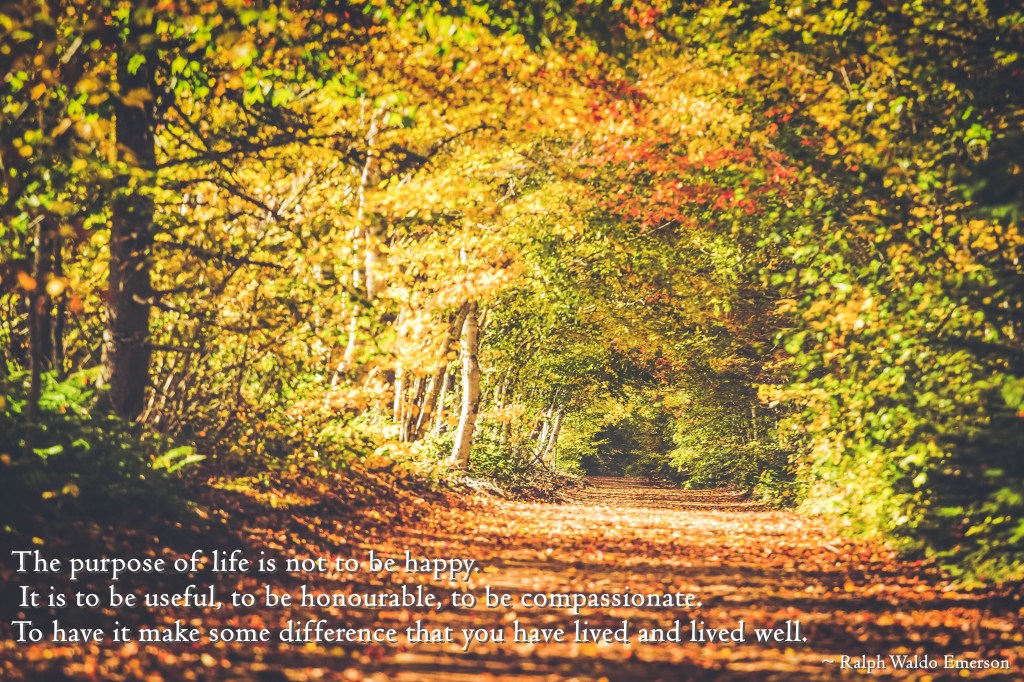
What matters most? Which unmet need lies behind the despondency? One of my favourite quotes is from American philosopher Ralph Waldo Emmerson: “the purpose of life is not to be happy. It is to be useful, to be honourable, to be compassionate, to have it make some difference that you have lived and lived well.” Here, living well is subjective. To help identify what motivates us, we can’t go past the Values-in-Action Character Survey.
Once you are clear about your values, identify 1-2 goals that align with these values. Taking concrete steps towards the life you want is one way to create meaning for yourself. - Make space for altruism and activism
Participating in something bigger than ourselves can protect against despondency. Activism is altruism in action. It allows us to focus on what we ourselves bring to the world, rather than what we’re getting or not getting. In this way we’re actively helping to build the kind of world we want to live in. - Choose what has meaning
I’ve previously written about author David Foster Wallace’s 2005 commencement speech given to students graduating from Kenyon College.
I now focus on a specific part of his speech:
“Twenty years after my own graduation, I have come gradually to understand that the liberal arts cliché about teaching you how to think is actually shorthand for a much deeper, more serious idea: learning how to think really means learning how to exercise some control over how and what you think. It means being conscious and aware enough to choose what you pay attention to and to choose how you construct meaning from experience. Because if you cannot exercise this kind of choice in adult life, you will be totally hosed. Think of the old cliché about “the mind being an excellent servant but a terrible master.”
Life will be unfair. It will be messy. It will leave us almost broken at times. How we respond will ever remain our choice. - Zoom out (but not too far)
Meaning and fulfilment are best found from a certain vantage point. Too close to your problems and you can’t see the opportunities. Too far away from them and everything blurs together and loses all meaning so that again, opportunities become obscured.
This is also true for systemic/societal problems. From a balanced perspective, we can see that humanity is (and always will be) deeply flawed, but is ultimately hardwired to thrive. Small, or even large, set-backs don’t spell the end of our collective existence. I don’t say this glibly. I’m painfully aware that human endurance and expansion has come at the expense of other humans – and that the vast majority of this has been avoidable. But it is also true that we can only improve humanity’s track record if we remain engaged. Apathy and nihilism are where hope goes to die. And the majority of us don’t want to live like that.
This realisation comes full circle then, as we grasp that letting go of our own unrealised hopes does not have to render the rest of our lives meaningless.
All of this culminates in one final aspect of meaning-making:
- Transform your locus of control
Our locus of control is the degree to which we believe we can control the outcome of events in our lives. Those with an external locus of control often struggle to find their purpose in life because they consistently focus their energy on events and people outside of their influence. This is generally through externalising behaviours (blame, helplessness, pessimism, reliance on fate or chance) or internalising behaviours (inherent negative core beliefs about the self).
In contrast, those with a strong internal locus of control are more likely to believe they can influence the overall trajectory of their lives. To do this, they focus their attention on what they can control (hint: their learning and growth, their thoughts, feelings, decisions, actions and reactions).
An internal locus of control doesn’t make us immune to set-backs. But it does allow us to learn and re-focus rather than collapsing in a helpless heap when things go wrong.
This fantastic how-to video (20 min) from Emma McAdam offers 4 steps for transforming an external locus of control into an internal one.
Not all of these ideas are going to resonate with everyone. But hopefully there is enough to leverage the next time we’re tempted to think that there is no point to anything.
Image credit: Melita Caulfield
Additional resources:
- Fujita, F. (2008). The frequency of social comparison and its relation to subjective well-being. In M. Eid & R. J. Larsen (Eds.), The science of subjective well-being (pp. 239–257). The Guilford Press.
- The Summer Day – Mary Oliver 1992
 This One Too